The problem
An email team sending to five countries runs on a spreadsheet calendar, feedback scattered across chat threads and PDFs, translators copying text out of the email by hand, and approvals nobody can find three months later when someone asks who signed off on that discount.
The email platforms send the email well. They don't run the process around it, and they charge per seat, so legal, translators and the client's marketing director never get a login anyway.
What I built
One workspace that covers the steps before and after the send, and works alongside whichever email platform the team already uses.
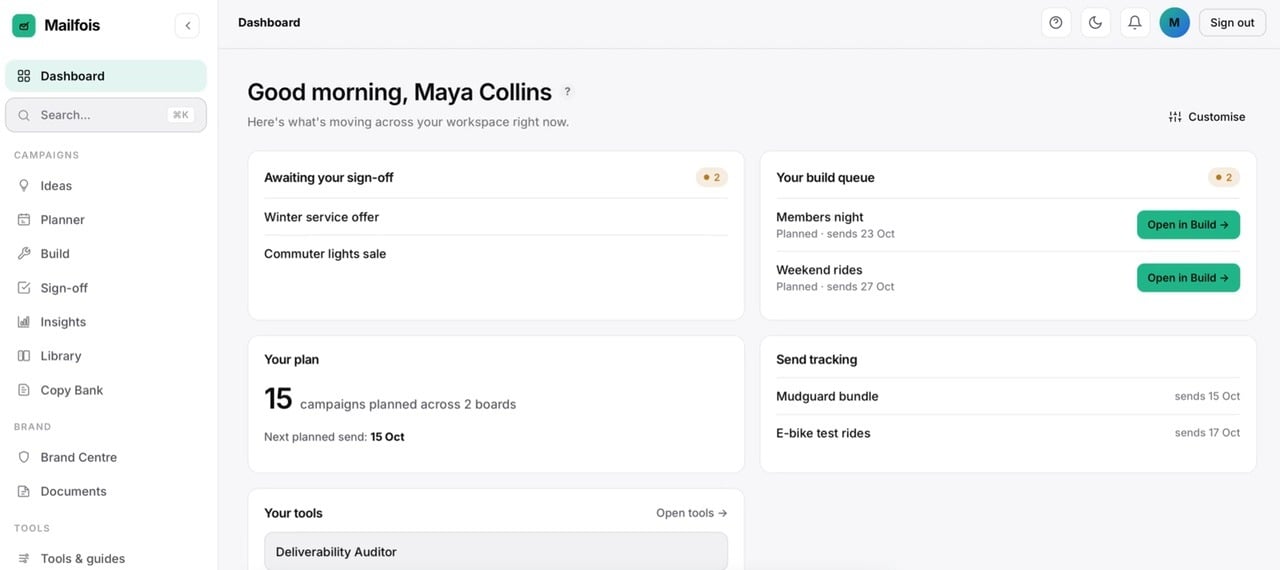
An in-house team's dashboard: what's waiting for approval, what's being built, and what sends next. Demo data.
The hard parts
Permissions, three ways
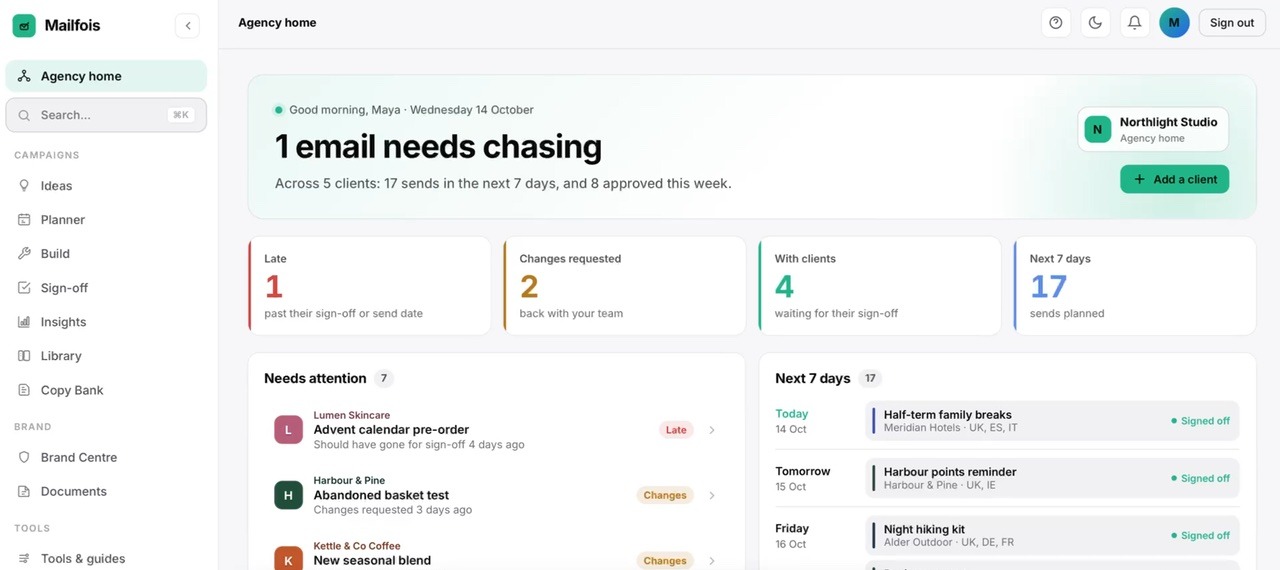
Mailfois has in-house teams, agencies working across several client brands, and outside approvers with no account at all. Each sees exactly what they should, enforced in the database with row-level security on every table, not just hidden in the interface. If a page ever had a bug, the data underneath still wouldn't leak.
A checker people can trust
It would have been easy to put AI on the brand check and call it smart. I deliberately didn't. Brand Guard is deterministic: the same email always gets the same result, and every finding points to the exact problem and how to fix it. AI shows up in one place only, as optional alt-text suggestions for images, switched on per image.
Never silently dropping a word
Pulling copy out of real-world HTML email, with its nested tables, hidden preheaders and Outlook workarounds, sounds simple. Missing one sentence means a market sends an email with English in it. The extractor is built around one rule: never silently drop copy.
Most business software comes down to the same three things: the right people seeing the right data, a clear record of who did what, and rules your team can rely on. That is exactly what Mailfois is built from.
Where it is now
Mailfois is live with a free plan and a set of free tools, with paid team plans built in. It's early: I'm now putting it in front of its first pilot teams, and their feedback is shaping what comes next.